Analysis · From infrastructure to use
Trust Is Infrastructure Too
Dispute resolution as a design requirement for shared digital services
The public value of an interoperable system depends on how predictably it repairs failures, as well as how efficiently it completes successful transactions.

The argument
A failed payment reveals the institutional chain hidden behind a simple customer instruction. The sender may use one wallet, the recipient another, while switching, settlement, and cash access involve additional actors. Each organization can hold a valid fragment of the record without anyone taking responsibility for the complete customer journey. That is an accountability problem with technical consequences.
The operational record describes GIMACDisputes entering production to standardize claims across the regional ecosystem. They report more than 100 connected institutions, with 250+ operational agents handling mobile or transfer claims and 220+ handling card claims. These figures describe organizational reach and operational capacity. They do not establish how quickly customers recover funds or whether complaint outcomes are equitable.
My central inference is that redress must cross the same boundaries as the transaction. A common case identifier, evidence standard, and escalation path can reduce repeated explanations and missing information. But an automated workflow is insufficient if liability is unclear, participating institutions miss response deadlines, or the customer cannot reach the service. Accountability must remain identifiable even when processing is distributed.
This lesson extends beyond payments to digital identity, government benefits and data-enabled services. An incorrect identity match or rejected entitlement can interrupt a person's access to essential services. Correction channels should be accessible without assuming high literacy, a smartphone or continuous connectivity. Safeguards become operational when people can challenge decisions and obtain a remedy, not merely when a privacy policy exists.
The analytical issue is the allocation of responsibility in a distributed service. If every participant can attribute the failure to another institution, users carry the cost of uncertainty. A scheme-level remedy obligation can change that incentive, but it must be matched by evidence-sharing and enforceable participant duties. Redress data also provides a diagnostic of where the architecture repeatedly fails particular users.
From question to implementation
For a regional platform, incident prevention and individual redress require different but connected arrangements. Cybersecurity teams address system threats; complaint teams restore individual positions; oversight bodies examine recurring patterns. The data exchanged between them should be sufficient for resolution and protected by role-based access, retention limits, and audit trails. A case-management platform should not become an unrestricted repository of personal information.
AI could assist with routing cases, detecting duplicate submissions, or summarizing evidence. These are potential uses, not demonstrated GIMAC deployments. Automated summaries require verification; consequential decisions need an accountable reviewer and a route of appeal. Faster processing would be a poor result if it increased wrongful closures or made unfamiliar languages harder to handle.
I would assess trust through the distribution of recovery time, unresolved balances, and repeat incidents, rather than a single average closure rate. A case marked closed may still leave a customer dissatisfied or unpaid. The World Bank's emphasis on security throughout the DPI lifecycle [D] supports prevention; the GIMAC lesson adds a complementary requirement to make restoration measurable.
Accountability across a failed payment
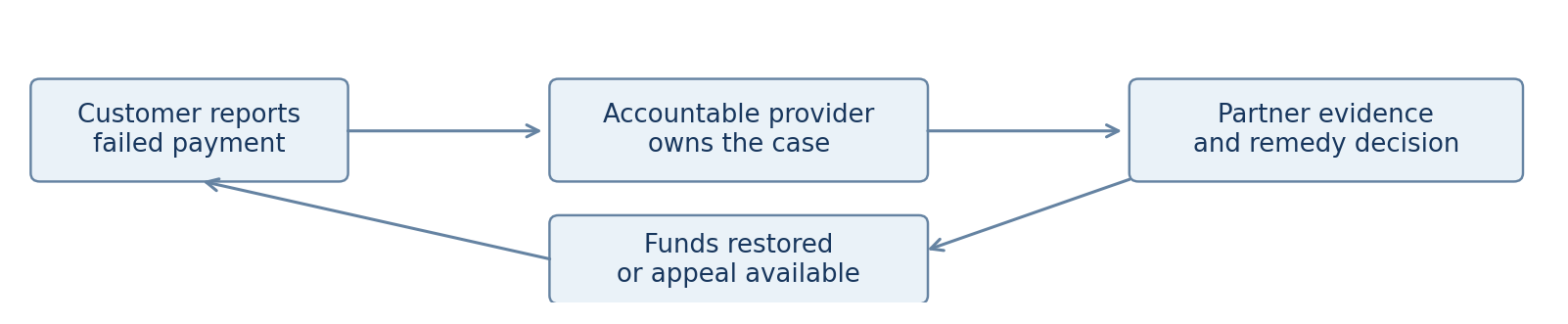
Assessment focus: time to acknowledge case; complete case files and handoff delays; time to funds restored and reopened cases.
Implications for practice
- Measure customer recovery separately from administrative case closure.
- Feed recurring failure patterns into service design and participant supervision.
Evidence & sources
Evidence and source note GIMACDisputes production and operational figures as reported in the operational notes; no independently verified resolution performance supplied. Security context: [D]. AI uses are recommendations.
These are practitioner reflections, not peer-reviewed impact studies or an official GIMAC or World Bank position. GIMAC figures come from the supplied notes and remain attributed to their reporting scope. New frameworks and diagrams are analytical proposals; they have not been validated as causal models. Approval, deployment, active use and economic impact are kept distinct.