Active acceptance
Measure the share of deployed merchants receiving payments over 30- and 90-day windows.
Gabon · Merchant payments · DPI
I coordinated testing and production preparation with 11 Gabonese institutions. Within the MAGIDIPAIE programme, interoperable QR payments connect a national digitalisation ambition with everyday merchant acceptance. Deployment counts are project results; active acceptance and repeat transactions require separate evidence.
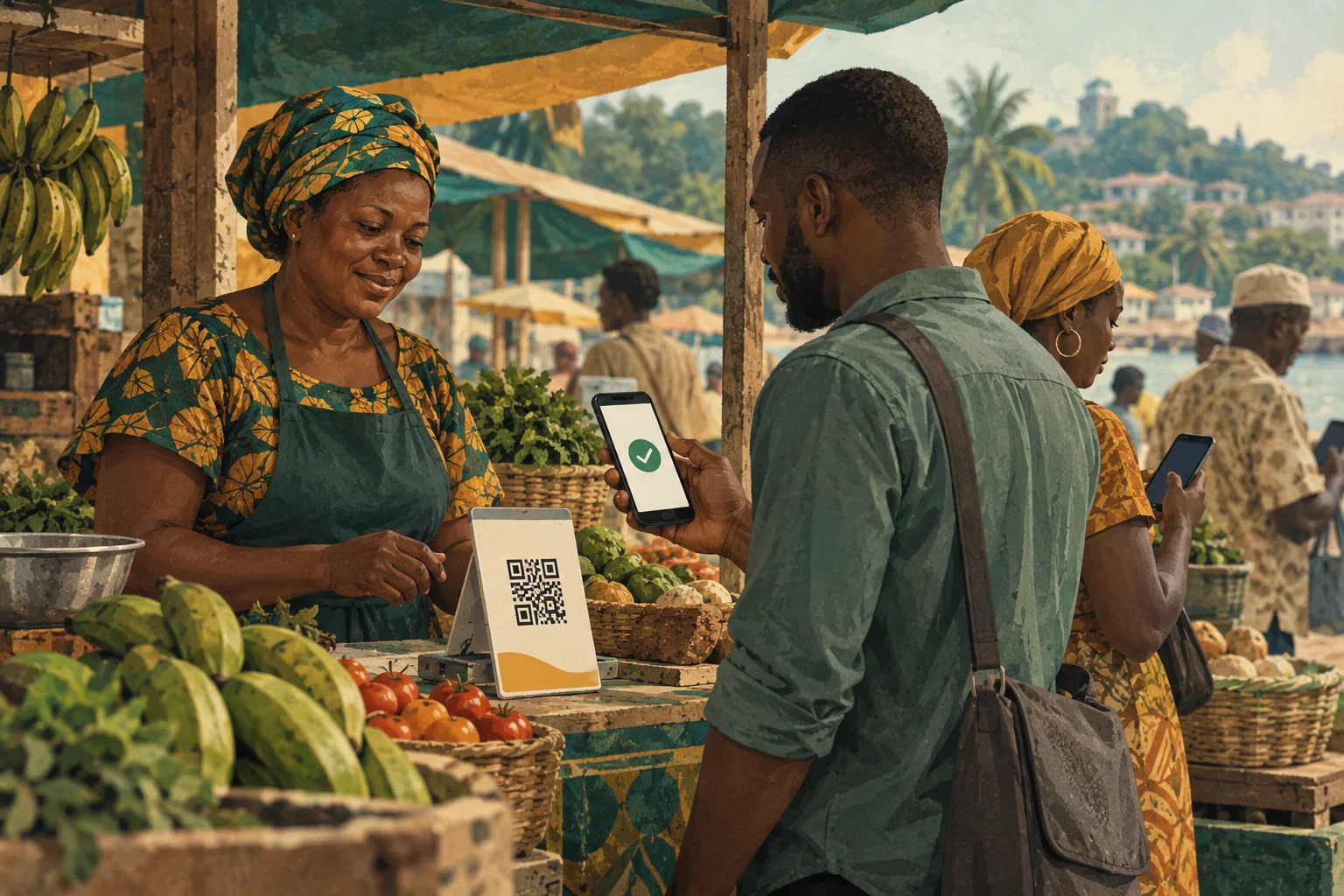
My coordination scope: testing and preparation toward production readiness.
Broader project-reported count; distinct from the programme snapshot below.
Active acceptance, successful payments and repeat merchant transactions.
MAGIDIPAIE is a programme of Gabon’s Ministry of Digital Economy, Digitalisation and Innovation involving banks, microfinance institutions, the public Treasury, payment institutions and fintechs. Its ambition brings together payments for the State and citizens, widespread merchant QR acceptance and the digitalisation of public services.
I coordinated 11 Gabonese institutions across implementation cohorts, tracking dependencies, testing and production preparation. My role focused on institutional readiness for interoperable acceptance; merchant rollout and the national programme’s wider results belong to the project and its participating institutions.
Programme objectives include a national payment system for the State and citizens, adoption of QR by all merchants, digitalisation of all State services and required digitalisation of private entities. These are stated programme ambitions; this case does not establish that all services are digitised or that a legal obligation has been enacted.
Banks, microfinance institutions, the Treasury, payment institutions and fintechs form the programme’s stakeholder base.
Coordinate technical dependencies, testing and production preparation across 11 institutions; readiness is assessed institution by institution.
The programme account names nine participants: BGFIBANK, Airtel Money, Moov Money, CLICKPAY, FINAM, SODEC, BAKOAI, BCEG and ECOBANK.
The account reports 2.8 million wallets and 1,010 QR codes deployed. Wallets do not necessarily represent distinct people, active users or connected programme users.
The case brief reports more than 2,000 merchants with QR deployed. Its reporting scope differs from the 1,010-code snapshot; dates and counting definitions must be reconciled before interpreting growth.
The following delivery framework separates the programme’s goals from what an interoperable payment must accomplish in practice.
| Workstream | Practical requirement | Evidence to collect |
|---|---|---|
| Institutional readiness | Compatible implementations, completed testing and production preparation. | Certification, resolved dependencies and live service availability for each participant. |
| Merchant acceptance | A merchant can receive payments from customers using different participating banks or wallets. | Active merchants, successful payments, settlement confirmation and repeat use. |
| Public-service payments | Collections must connect payment confirmation with the relevant public-service record. | Live integrations, reconciliation quality and service completion; objectives alone are insufficient. |
| Merchant economics | Charges, settlement access and support must fit small-business needs. | Effective costs, settlement times, retention and merchant feedback. |
| Trust and inclusion | Accessible onboarding, clear confirmation and a way to resolve failed or disputed payments. | Failure rates, complaint resolution and barriers faced by underserved merchants. |
Counts describe different units: 11 institutions coordinated, nine named Group 1 production participants, 1,010 deployed QR codes in a programme snapshot and more than 2,000 merchants in broader reporting. They should not be added together or treated as interchangeable.
The customer and merchant can use different providers. Shared rules and reliable confirmation make that connection useful.
A customer initiates payment using a participating bank or wallet.
A common QR standard identifies the merchant across providers.
Connected institutions route and process the payment under common rules.
Confirmation, accessible funds and reconciliation complete the experience.
Coordination toward readiness involved 11 institutions. This describes the scope of my work, rather than 11 institutions confirmed in production.
The account reports 2.8 million wallets and 1,010 QR codes, without a reporting date. These are footprint indicators; they do not establish active payment use.
More than 2,000 merchants with QR deployed is a project-reported result. Different scopes and counting units prevent a direct comparison with the QR-code snapshot.
Measure the share of deployed merchants receiving payments over 30- and 90-day windows.
Track recurring merchant activity, customer repeat use and payments across different providers.
Monitor successful completion, confirmation delays, settlement access, fees and complaint resolution.
Evidence basis: practitioner case account, consultation narrative and project-reported figures. This is a delivery reflection, not an independent impact evaluation. Reporting scopes and uncertainties are identified above.
A QR deployment becomes infrastructure for economic opportunity when merchants can accept payments reliably and choose to keep using the service. National coordination creates reach; merchant economics and trust determine whether that reach becomes routine commerce.
Connect payment rollout to public-service workflows and business needs. A national programme needs both institutional coordination and usable frontline services.
Treat common standards, readiness testing and operational support as complementary requirements. Technical connection is one stage of delivery.
Define the units and reporting dates before comparing rollout figures. Measure use and service quality separately from wallets and QR deployment.
Interested in the evidence or a research conversation?
Contact Exode ↗