Analysis · From national DPI to regional DPI
Africa Cross Border Payment Architecture
Connecting existing systems through accountable federation
A federated architecture can preserve useful local infrastructure while widening reach. Its success depends on settlement, liability, and customer protection across every connected layer.

The argument
African payment infrastructure is developing at domestic, regional, and continental levels. A design choice follows: when should an institution connect directly, when should a regional system aggregate connectivity, and when should a continental mechanism provide wider reach? A useful architecture answers these questions by considering costs, risks, and service needs, rather than requiring every payment to traverse the same hierarchy.
GIMACPAY illustrates the regional aggregation role in a common-currency setting. Existing links across six CEMAC countries can potentially reduce repeated integrations with external networks. PAPSS-related discussions and reciprocal ecosystem models in the practitioner record remain workstreams; they should not be presented as completed continental interoperability. The value proposition is reusable regional reach, subject to agreements and validation.
A national-to-regional-to-continental sequence is a helpful schematic, but it is not a mandatory topology. Some national systems may connect directly to wider mechanisms; some services may need bilateral routes. The goal is consistent interoperability without unnecessary duplication. Regional aggregation adds value when it lowers integration burdens or provides shared operational functions, not simply because another layer exists.
Cross-currency payments introduce risks that a common-currency switch does not resolve. Foreign-exchange pricing, liquidity, settlement finality, and compliance must be defined across the linked systems. Technical speed at one switch says little about the complete journey. A payment can route quickly while waiting for a compliance check, beneficiary validation, or funds at the receiving provider.
Federation trades reduced integration duplication against added coordination and dependency. A regional hub may simplify connections for members while introducing another point whose failure affects many routes. The architecture should compare alternatives under both normal and stressed conditions. The optimal route for one corridor need not be the best route for another with different currencies, volumes or regulatory requirements.
From question to implementation
The CPMI's interlinking report emphasizes governance and oversight arrangements [G]. Applied to this proposal, the critical questions are who operates the link, who supervises it, and who bears a loss when a payment fails across boundaries. Participants also need compatible messaging, data requirements, sanctions controls, and procedures for mistaken or fraudulent transfers.
The ongoing assessment of a SWIFT-to-GIMAC gateway offers a related example. The target of no more than 30 seconds from GIMAC receipt to wallet credit is a final-leg ambition subject to technical validation. It is not an achieved end-to-end cross-border benchmark. Performance reporting should distinguish that segment from originating-network processing, foreign exchange, and other upstream steps.
I would evaluate the federation based on total delivery cost, predictability of recipient credit, corridor coverage, and the integration effort required of a new participant. Concentration risk and contingency routes also matter. A shared gateway can simplify access but also become a critical dependency. Interoperability should include a plan for what happens when the gateway, a partner, or a settlement arrangement is unavailable.
Federated connections with shared rules
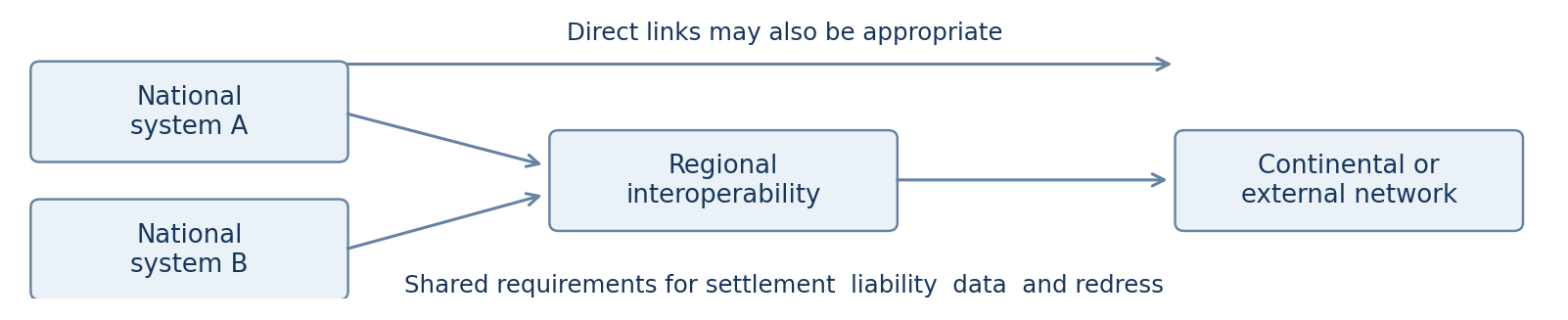
Assessment focus: total cost and reachable institutions; predictable credit and defined loss allocation; agreed supervision and dispute handling.
Implications for practice
- Assess complete customer journeys separately from the speed of a single processing segment.
- Treat regional and continental connections as arrangements to validate, not assumed achievements.
Evidence & sources
Evidence and source note Interoperability workstreams in the practitioner record; ongoing SWIFT gateway study and conditional target from the workstream record. Governance context: [G]. Diagram is conceptual.
These are practitioner reflections, not peer-reviewed impact studies or an official GIMAC or World Bank position. GIMAC figures come from the supplied notes and remain attributed to their reporting scope. New frameworks and diagrams are analytical proposals; they have not been validated as causal models. Approval, deployment, active use and economic impact are kept distinct.