Practitioner note · Practitioner notes
Cardless Withdrawal and Interoperable Services
Designing for journeys that still require cash access
Digital inclusion may require reliable bridges to cash. The relevant measure is whether the whole journey works for the user, including access, security, and recovery.

The argument
The GIMAC service configuration examined here enables a customer to generate a secure voucher from a mobile or bank wallet and use it at an enabled ATM without presenting a physical card. Withdrawals in that configuration are in multiples of XAF 5,000. This is a particular service rule, not a universal property of cardless withdrawals or a guarantee of availability at every ATM.
The journey joins account access, a redemption credential, and a physical cash point. That can be useful for a customer who has digital funds but does not hold or carry a bank card. It also shows why account connectivity alone is insufficient. ATM reach, cash availability, network uptime, and the customer's ability to authenticate determine whether the service can actually be used.
Cash remains part of many economic routines. A digital transformation program should understand those routines rather than making cashlessness its sole measure of success. The aim may be to reduce unnecessary travel or enable access across providers. Forced migration to a digital-only channel can exclude users when connectivity, merchant acceptance, or control over a device is limited.
The XAF 5,000 denomination rule creates a further design question. A voucher service may expand instrument choice but remain unsuitable for someone needing a smaller amount. Pricing and minimum amounts should be assessed against household and microenterprise cash needs. A service can be interoperable across institutions and still have important affordability or geographic constraints.
The service also illustrates a boundary between digital and physical infrastructure. Account interoperability can expand the eligible network without adding cash to a distant or depleted ATM. The binding constraint may lie at the cash point rather than the switch. Evaluation should locate that constraint before investing in another software feature or attributing low use to customer reluctance.
From question to implementation
The diagram isolates the authorization and redemption stages. A safe design needs explicit rules for voucher expiry, authentication, duplicate redemption, and failure recovery. The credential should not be treated as a permanent identifier or reused beyond its intended purpose. Lost messages, compromised phones and uncertain ATM outcomes need clear customer guidance and an accountable claims process.
These controls should be tested with realistic failure journeys. What happens if funds are debited but the ATM dispenses no cash? Who confirms the physical outcome? How is an expired voucher canceled and the balance restored? A successful demonstration tests only one path; operational readiness requires evidence that exceptional cases are handled predictably.
For global application, cardless services should be evaluated as part of a wider access strategy involving agents, ATMs, and merchant acceptance. Track successful completion after voucher issuance, travel distance, total charges, and time to restoration after failure. Accessibility and assisted channels matter. The service's value lies in improving the user's options, not merely expanding the catalog of interoperable features.
Cardless withdrawal journey
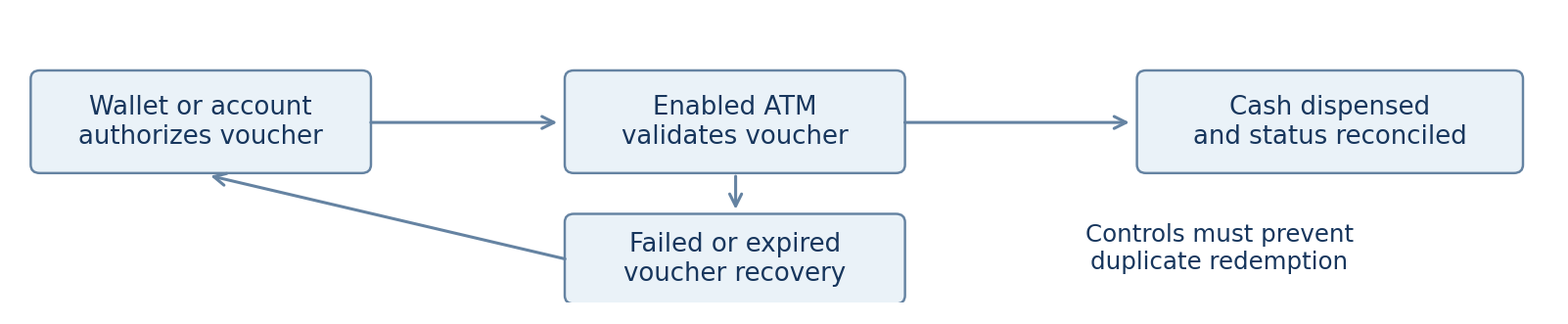
Assessment focus secure voucher with defined expiry; cash and transaction status reconciled; funds restored with traceable ownership.
Implications for practice
- Report voucher issuance separately from successful cash withdrawal.
- Review minimum amounts and cash-point reach against actual user needs.
Evidence & sources
Evidence and source note GIMAC cardless-withdrawal configuration and practitioner notes in the practitioner record. Control design and evaluation measures are recommendations, not claims about current implementation.
These are practitioner reflections, not peer-reviewed impact studies or an official GIMAC or World Bank position. GIMAC figures come from the supplied notes and remain attributed to their reporting scope. New frameworks and diagrams are analytical proposals; they have not been validated as causal models. Approval, deployment, active use and economic impact are kept distinct.